
The Revolutionists Play: A Comprehensive Guide (Updated April 30, 2026)
Finding a legal PDF of “The Revolutionists” script requires diligent searching, as availability varies; explore publisher websites and educational resource platforms for access options.
Google Translate facilitates instant translation between French and over 100 languages, aiding research for international productions or script analysis.
Remember to respect copyright laws when seeking and utilizing the play’s text, prioritizing authorized sources for ethical and legal compliance.
What is “The Revolutionists”? ⎯ An Overview
“The Revolutionists” is a compelling and darkly comedic play by Lauren Gunderson, offering a fresh perspective on the French Revolution. It uniquely centers the experiences of four women during this tumultuous period – Charlotte Corday, Olympe de Gouges, Robespierre, and Marianne Angelle – exploring their motivations and actions within the context of radical political upheaval.
The play isn’t a strictly historical retelling; rather, it’s a vibrant and imaginative exploration of ideas surrounding revolution, violence, and the pursuit of a better world. Gunderson masterfully blends historical fact with fictional elements, particularly with the character of Marianne, a Haitian revolutionary, to broaden the scope of the narrative.

While a readily available, free PDF of the full script can be challenging to locate due to copyright restrictions, resources like Samuel French (Concord Theatricals) often offer licensing and script access for performance rights. Educational institutions may also have access through digital library subscriptions. Google Translate can assist in understanding French-language resources related to the play’s reception and analysis.
Playwright Lauren Gunderson: Background and Style

Lauren Gunderson is one of America’s most produced playwrights, known for her intelligent, witty, and emotionally resonant works. She frequently tackles historical subjects, reimagining them through a contemporary lens, often focusing on the untold stories of women. Her plays are characterized by sharp dialogue, complex characters, and a blend of humor and pathos.
Gunderson’s style often incorporates meta-theatrical elements, breaking the fourth wall and engaging directly with the audience, as seen in “The Revolutionists.” She’s adept at exploring big ideas – love, loss, power, and identity – within compelling narratives. Obtaining a PDF of her scripts, including “The Revolutionists,” typically requires purchasing through theatrical publishing companies like Concord Theatricals.
Resources like Google Translate can be helpful when researching critical analyses of Gunderson’s work published in French or other languages. Her commitment to accessible and thought-provoking theatre has earned her widespread acclaim and a dedicated following.
Historical Context: The French Revolution & Reign of Terror
The French Revolution (1789-1799) was a period of radical social and political upheaval in late 18th-century France, ultimately toppling the monarchy and establishing a republic. This era was marked by ideals of liberty, equality, and fraternity, but descended into extreme violence during the Reign of Terror (1793-1794), orchestrated largely by Maximilien Robespierre.
Thousands were executed by guillotine, suspected of being enemies of the revolution. Accessing a PDF of “The Revolutionists” script allows for a deeper understanding of how Gunderson interprets and dramatizes this tumultuous period. Resources like Google Translate can aid in researching primary source documents from the era, originally written in French.
The play doesn’t aim for strict historical accuracy, but rather uses the context to explore broader themes of revolution, justice, and the cost of ideological fervor.
Key Characters & Their Historical Inspirations
“The Revolutionists” features a compelling quartet of women connected to the French Revolution. Charlotte Corday, a real historical figure, assassinated Jean-Paul Marat. Olympe de Gouges was a playwright and feminist who penned the “Declaration of the Rights of Woman and of the Female Citizen.” Robespierre, a central figure in the Reign of Terror, is portrayed with nuanced complexity.
Marianne Angelle is a fictional character representing the Haitian Revolution, highlighting the interconnectedness of global struggles for liberation. Obtaining a PDF of the script reveals Gunderson’s creative liberties with historical detail, prioritizing thematic resonance over strict biographical accuracy.
Utilizing online translation tools, like Google Translate, can assist in researching the original writings of de Gouges and understanding the context of these characters’ lives.
Charlotte Corday: The Radical and Her Motivations
Charlotte Corday’s radical act – the assassination of Marat – stemmed from her Girondin sympathies and belief that Marat fueled excessive violence. The play, accessible through a PDF version of the script, portrays her as driven by a desire to end the Reign of Terror, though her methods remain controversial.
Gunderson explores Corday’s internal conflict, questioning whether her actions were heroic or simply another act of political extremism. Studying the script reveals a character grappling with morality and the consequences of revolution. Resources like Google Translate can aid in understanding the political pamphlets and discourse of the era that influenced Corday’s views.
The PDF allows close examination of Corday’s dialogue, revealing her unwavering conviction and tragic fate.
Olympe de Gouges: Playwright & Feminist Advocate
Olympe de Gouges, a pioneering feminist and playwright, passionately advocated for women’s rights during the French Revolution. The play, obtainable as a PDF script, vividly portrays her struggle against societal norms and her demand for equality. Her “Declaration of the Rights of Woman and of the Female Citizen” challenged the revolutionary ideals of liberty and fraternity.
Gunderson’s depiction, accessible through the script’s text, highlights de Gouges’ unwavering commitment to social justice, even in the face of persecution. Resources like Google Translate can assist in analyzing her original writings and understanding the context of her activism.
The PDF version allows for detailed study of her character’s fiery spirit and tragic end, solidifying her legacy as a revolutionary icon.

Robespierre: The Architect of the Terror
Maximilien Robespierre, a central figure in the French Revolution, is portrayed in “The Revolutionists” as the chilling architect of the Reign of Terror. Accessing the play’s PDF script reveals Gunderson’s nuanced depiction of his unwavering, yet ultimately destructive, idealism. His commitment to virtue, ironically, led to widespread violence and executions.
The script allows for a close examination of his motivations and the justifications he used for his actions. Resources like Google Translate can aid in understanding the historical context of his speeches and decrees.
Studying the PDF version of the play provides insight into how Gunderson presents Robespierre’s complex character, challenging audiences to confront the dangers of unchecked power and ideological extremism.
Marianne Angelle: The Haitian Revolutionary (Fictionalized)
Marianne Angelle, a compelling fictional character in “The Revolutionists,” represents the Haitian Revolution and the often-overlooked contributions of people of color to the broader fight for liberation. Obtaining the play’s PDF script is crucial to understanding Gunderson’s deliberate inclusion of this narrative.

Her storyline, accessible through the script, highlights the interconnectedness of revolutions and the global impact of the French upheaval. Resources like online discussion forums, found after locating a PDF, can offer diverse interpretations of her role.
Analyzing the PDF reveals how Gunderson uses Marianne to challenge conventional historical narratives and amplify marginalized voices, prompting reflection on the complexities of revolution and freedom.
Plot Summary: A Breakdown of the Play’s Events
“The Revolutionists” unfolds as Charlotte Corday, Olympe de Gouges, and Robespierre grapple with their roles amidst the Reign of Terror. Accessing the play’s PDF script is essential for following the non-linear narrative and its interwoven timelines.
The plot centers on Charlotte’s decision to assassinate Marat, sparking a series of confrontations and philosophical debates. A PDF copy allows for detailed scene analysis, revealing Gunderson’s clever use of metatheatre.
Marianne Angelle’s presence, discovered within the PDF, adds a crucial layer, challenging the Eurocentric focus of the historical period. The play culminates in a powerful exploration of legacy and the cyclical nature of revolution, best understood through close textual study of the script.
Themes Explored in “The Revolutionists”
“The Revolutionists” powerfully examines revolution, violence, and female agency, themes readily accessible through a detailed reading of the play’s PDF script. The PDF reveals Gunderson’s nuanced portrayal of how ideals can be corrupted during times of upheaval.
Gender roles are central, with Olympe de Gouges’s fight for women’s rights vividly depicted; a PDF allows for tracing the development of her arguments. The play also questions the power of propaganda and ideas, offering a critical lens on historical narratives.
Furthermore, the PDF highlights the characters’ confrontation with mortality and their desire to leave a lasting legacy, prompting reflection on the complexities of revolutionary action and its consequences.
The Nature of Revolution & Violence
Accessing a PDF version of “The Revolutionists” allows for a close examination of Gunderson’s depiction of revolution’s inherent contradictions. The script reveals how easily noble intentions devolve into brutal violence, particularly during the Reign of Terror.
The PDF showcases the characters’ grappling with the justification of violence as a means to achieve political change, questioning whether the ends truly justify the means. It highlights the cyclical nature of violence, demonstrating how one act of aggression often begets another.
Through the PDF, readers can analyze the play’s exploration of revolutionary fervor and its impact on individual morality, prompting a critical assessment of the costs of radical transformation.
Gender Roles & Female Agency
A PDF copy of “The Revolutionists” is crucial for dissecting Gunderson’s subversion of traditional historical narratives concerning women’s roles during the French Revolution. The script powerfully illustrates the limited agency afforded to women within a patriarchal society, even amidst revolutionary upheaval.
Examining the PDF reveals how characters like Olympe de Gouges and Charlotte Corday actively challenge societal expectations, utilizing their intellect and courage to advocate for political and social change. The play, accessible through the PDF, demonstrates their struggles for recognition and influence in a male-dominated world;
The PDF allows for detailed analysis of how Gunderson reclaims these women’s stories, giving voice to their perspectives and highlighting their contributions to the revolutionary period, beyond conventional historical accounts.
The Power of Ideas & Propaganda
Accessing a PDF version of “The Revolutionists” is essential to understanding Gunderson’s exploration of how ideas—and their manipulation—fueled the French Revolution. The script vividly portrays the potency of propaganda in shaping public opinion and justifying violence.
Through the PDF, one can analyze how characters utilize rhetoric, pamphlets, and plays (within the play itself!) to advance their political agendas. The text demonstrates how easily narratives can be constructed and disseminated to control the populace, even with noble intentions.
The PDF allows for close reading of dialogues revealing the characters’ attempts to define “truth” and influence others through persuasive language. Gunderson, via the PDF’s accessible text, highlights the dangerous intersection of ideology and power during times of radical change.
Mortality and Legacy
A PDF copy of “The Revolutionists” allows for focused examination of the play’s poignant meditation on mortality and the enduring question of legacy. The characters grapple with the fleeting nature of life amidst the Reign of Terror, acutely aware of their potential for historical erasure.
Through the script’s PDF format, one can trace how each woman—Corday, de Gouges, Angelle, and even Robespierre—contemplates what will remain of their actions and beliefs after their deaths. The play, accessible via PDF, challenges the notion of a fixed historical narrative.
Analyzing the PDF reveals Gunderson’s exploration of how legacies are constructed, contested, and often rewritten by subsequent generations. The play, in its PDF form, prompts reflection on the responsibility of remembering and the complexities of historical judgment.
Dramatic Structure & Style
Accessing “The Revolutionists” as a PDF facilitates a detailed study of Lauren Gunderson’s innovative dramatic structure. The play eschews traditional linear storytelling, employing a fragmented, meta-theatrical style that mirrors the chaos of the French Revolution.
A PDF version allows close reading of the play’s direct address to the audience, breaking the fourth wall and prompting active engagement with the themes. Gunderson’s use of humor, juxtaposed with the grim historical context, is readily apparent within the PDF’s text.

The PDF reveals a structure built around vignettes and evolving relationships between the characters, rather than a conventional plot arc. This stylistic choice, easily observed in the PDF, emphasizes the play’s thematic concerns over narrative progression, creating a uniquely compelling theatrical experience.
Critical Reception & Reviews
Analyzing reviews via a readily available PDF of “The Revolutionists” script allows for cross-referencing commentary with Gunderson’s text. Critics consistently praise the play’s sharp wit and insightful exploration of female agency during a tumultuous period.
Access to the PDF aids in understanding how directorial choices impact the reception of Gunderson’s meta-theatrical style. Many reviews highlight the play’s success in balancing historical accuracy with contemporary relevance, a nuance easily appreciated when studying the PDF.
The PDF format enables detailed textual analysis to support or challenge critical interpretations. Reviews often commend the play’s ability to provoke discussion about revolution, violence, and the legacies of historical figures, all discernible within the PDF’s pages.

Productions & Performance History
A digital PDF copy of “The Revolutionists” script is invaluable for tracking production notes and directorial interpretations across various stagings. Early productions, accessible through archived programs often found alongside PDF versions, demonstrate the play’s adaptability.
Studying the script in PDF format alongside production photos reveals how designers and actors have interpreted Gunderson’s vision. Regional theatre productions, documented through reviews and occasionally PDF-accessible playbills, showcase the play’s widespread appeal.
The PDF allows for comparative analysis of casting choices and staging techniques. Notable productions, often discussed in critical reviews linked to online PDF resources, highlight the play’s enduring relevance and continued popularity within theatrical circles.
Notable Productions & Casts
Accessing production details, often compiled in PDF program booklets, reveals key casting choices that shaped interpretations of “The Revolutionists.” Early stagings, documented in searchable PDF archives, frequently featured emerging talents alongside established actors.
The play’s initial runs, details of which can be found in PDF press releases, showcased diverse casts reflecting the play’s themes of female empowerment. Examining cast lists within PDF production reports highlights the importance of nuanced performances.
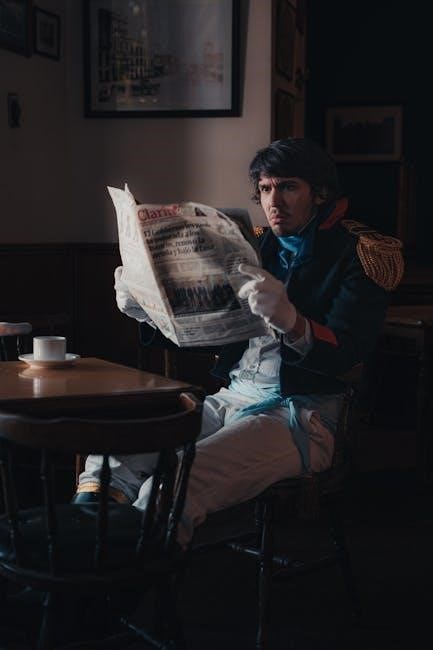
Later, nationally recognized productions, often accompanied by PDF promotional materials, attracted prominent actresses. Analyzing these PDF resources allows for a comparative study of how different actors approached the complex characters, enriching our understanding of the play.
Staging & Design Elements
Detailed insights into staging and design are often preserved in production PDF documents, including set designs, costume sketches, and lighting plots. These PDF resources reveal how directors visually interpreted the play’s revolutionary fervor and intimate character studies.
Early productions, documented in accessible PDF program notes, often employed minimalist sets to emphasize the characters’ intellectual battles. Later stagings, showcased in PDF production photos, experimented with more elaborate designs, reflecting evolving directorial visions.
Costume design, frequently detailed in PDF lookbooks, played a crucial role in distinguishing characters and highlighting their social positions. Analyzing these PDF materials demonstrates how visual elements amplified the play’s themes of power, identity, and rebellion.
“The Revolutionists” PDF Availability & Resources
Locating a legitimate PDF of Lauren Gunderson’s “The Revolutionists” script can be challenging due to copyright restrictions. Play publishers, like Dramatists Play Service, are primary sources, though PDF access often requires purchase or subscription.
Educational institutions sometimes provide students with PDF versions for study purposes. Online databases specializing in dramatic literature may also offer access, but verifying legality is crucial. Beware of unauthorized PDF downloads, as they infringe copyright.
Searching for production-related PDFs – study guides, program books, or promotional materials – can offer valuable insights, even if the full script isn’t available. Google Translate can assist with resources in other languages.
Where to Find the Script (Legally)
Securing a legal copy of “The Revolutionists” script, in PDF or physical format, begins with authorized sources. Dramatists Play Service is the official publisher and a reliable starting point for purchase. Samuel French (Concord Theatricals) may also offer licensing and script access.
University and college libraries frequently stock play scripts for academic use, potentially providing PDF access to enrolled students. Some online booksellers offer legitimate digital copies, but always verify the seller’s credentials.
Avoid unofficial websites offering free PDF downloads, as these constitute copyright infringement. Utilizing Google Translate to navigate international publisher sites can broaden your search, ensuring legal acquisition.
Study Guides & Educational Materials
While a dedicated official study guide in PDF format for “The Revolutionists” may be limited, resourceful educators and students can compile materials. Many theatre resource websites offer general play analysis guides adaptable to Gunderson’s work.
University course syllabi focusing on the play are often publicly available online, providing valuable insights and discussion questions. Utilizing Google Translate to access resources in French or other languages can expand research.
Consider supplementing with historical context materials on the French Revolution and feminist theory. Examining critical reviews (often accessible through library databases) offers diverse interpretations. Remember to ethically source all materials and respect copyright when creating or sharing a compiled PDF study guide.
Online Discussion Forums & Communities
Engaging with online communities dedicated to theatre and Lauren Gunderson’s work can be invaluable when exploring “The Revolutionists.” While direct PDF script sharing may be restricted due to copyright, forums often host discussions about interpretations, character analyses, and thematic elements.
Reddit’s r/theater and similar subreddits can provide a platform for asking questions and sharing resources. Facebook groups focused on playwriting or feminist theatre may also offer relevant conversations. Utilizing Google Translate can broaden access to international forums.
Remember to participate respectfully and adhere to community guidelines. These spaces are excellent for finding alternative perspectives and supplementing your understanding of the play, even without a readily available PDF.
Analyzing Key Scenes & Dialogue
A close examination of pivotal scenes in “The Revolutionists” reveals Gunderson’s masterful use of language to explore complex themes. While a PDF script is helpful, even scene summaries can fuel insightful analysis. Focus on the interplay between Charlotte Corday, Olympe de Gouges, and Robespierre, noting how their dialogue reflects their ideologies.
Consider the scene where Olympe drafts her “Declaration of the Rights of Woman and the Female Citizen,” and how it contrasts with Robespierre’s rhetoric. Utilizing Google Translate to compare French historical texts can enrich understanding.
Analyzing the play’s meta-theatrical elements—characters aware of their fictional status—adds another layer of interpretation. Accessing a PDF facilitates detailed textual study, but careful observation of performance recordings can also be revealing.
The Play’s Relevance Today
“The Revolutionists” resonates powerfully with contemporary audiences grappling with issues of social justice, political polarization, and gender equality. Accessing a PDF of the script allows for focused study of Gunderson’s nuanced portrayal of revolutionary fervor and its consequences.
The play’s exploration of the dangers of extremism and the manipulation of ideology feels particularly pertinent in today’s climate. Google Translate can aid in researching historical parallels to current events, deepening understanding.
Furthermore, the play’s focus on female agency and the fight for recognition remains vital. A readily available PDF encourages wider academic study and performance, fostering continued dialogue about these crucial themes. The play serves as a potent reminder of the ongoing struggle for a more just and equitable world.
Similar Plays & Further Reading
For those captivated by “The Revolutionists,” exploring works tackling historical upheaval and female empowerment is highly recommended. Obtaining a PDF of Gunderson’s play facilitates comparative analysis with other scripts.

Consider plays like “Marie Antoinette” by David Adjmi, which similarly re-examines historical figures through a modern lens. Researching these plays, aided by tools like Google Translate for international sources, enriches understanding.
Further reading could include biographies of Charlotte Corday, Olympe de Gouges, and Robespierre. Accessing a digital PDF of “The Revolutionists” alongside these resources allows for a comprehensive exploration of the era and its complexities. Examining these texts collectively illuminates the enduring power of revolutionary ideals and their often-tragic consequences.
Impact of the Play on Contemporary Discourse
“The Revolutionists” has sparked vital conversations about female agency, political extremism, and the legacies of revolution, often fueled by readily available script access – a PDF version being particularly useful for study groups.
The play’s exploration of historical figures through a feminist lens resonates with contemporary movements advocating for gender equality and social justice. Utilizing digital resources, including a downloadable PDF, allows wider accessibility for academic and activist circles.
Its depiction of violence and ideological fervor prompts reflection on current political climates. Google Translate aids in understanding international responses to the play’s themes. The play’s impact extends beyond theatrical spaces, influencing discussions on power, representation, and the ongoing struggle for a more equitable world.